
The Ultimate Guide to Wide Guard Comb Attachments
So what changed? Was it simply the wider width? Or is there more happening beneath the surface?
The answer lies in how a guard comb interacts with the coat as it enters the blade. Factors such as blade width, tooth spacing, tooth count, coat guidance, and feed characteristics all influence how efficiently hair is presented to the cutting edge of the clipper blade, and how cleanly the coat is finished.
Yet despite their popularity, many groomers still experience the same frustrations:
Visible track lines
Poor coat feed
Hair collapsing before it reaches the blade
Coat snagging or skipping
Multiple unnecessary passes
Inconsistent finishes that require additional blending
These problems are often blamed on grooming technique alone.
In reality, technique is only one part of the equation. The engineering of the guard comb itself plays an equally important role.
Many wide guard comb attachments look remarkably similar. At first glance, it's easy to assume they all perform the same. After all, they fit the same wide clipper blades, are often made from similar materials, and accomplish the same basic task—leaving a longer, even coat length.
So, is there really a difference? Do all wide guard comb attachments produce the same grooming results?
That's a question many groomers ask, especially when comparing different brands or deciding whether changing guard comb systems is worthwhile.
The answer is more complex than a simple yes or no. While many wide guard combs share similar design characteristics, subtle differences in engineering—such as tooth geometry, tooth spacing, coat guidance, rigidity, and how hair is presented to the blade—can influence how smoothly the coat feeds, how consistently it cuts, and the quality of the finished result.
Those design differences are the focus of this guide.
What Is a Wide Guard Comb?
A wide guard comb attachment is designed to fit securely over a compatible wide clipper blade, allowing groomers to leave a consistent, longer coat length while covering significantly more coat with every pass.
Although the guard comb attachment determines the finished coat length, it does not cut the hair itself. The clipper powers the blade, the blade performs the cutting, and the guard comb attachment controls how much coat reaches the cutting edge.
It's important to understand the relationship between the three parts that work together:
The clipper
The wide clipper blade
The wide guard comb attachment
The purpose of the wide guard comb is to control how much coat reaches the cutting edge of the blade while maintaining a consistent distance between the blade and the dog's skin. The clipper provides the power, the blade performs the cutting, and the guard comb controls the finished coat length.
Unlike standard guard comb systems, wide guard combs are designed to fit wide clipper blades, which have a cutting surface approximately 35% wider than a traditional A5 blade. That additional cutting width allows more coat to feed into the blade with every stroke, helping groomers cover larger sections of coat more efficiently.
Although wide guard comb systems were originally embraced for grooming large breeds, groomers quickly discovered that the wider cutting path also improved efficiency on many medium and smaller breeds. Today, experienced groomers routinely reach for wide guard combs on everything from Goldendoodles and Standard Poodles to Cocker Spaniels, Terriers, and many everyday pet trims.
The wider blade doesn't simply make grooming faster because it's larger. It changes how the coat is presented to the cutting edge, how much hair is captured with each pass, and how consistently the coat can be finished.
Understanding that relationship is the foundation for everything else you'll learn throughout this guide.
What Is Coat Feed?
If there is one concept that separates average clipping results from exceptional ones, it's understanding coat feed. Coat feed describes how hair enters, travels through, and is presented to the cutting edge of the clipper blade.
Every pass you make with a guard comb attachment begins long before the blade cuts a single hair.
As the attachment moves through the coat, its teeth begin separating, organizing, and guiding the hair toward the blade. Ideally, the coat remains supported and evenly presented until it reaches the cutting edge, allowing the blade to remove the hair at a consistent length.
When coat feed is smooth and controlled, the result is often:
A cleaner finish
Greater consistency
Fewer visible track lines
Less snagging
Fewer repeated passes
Reduced scissor blending
Faster results
When coat feed is disrupted, the opposite can happen. Hair may bend, collapse, slip between the teeth unevenly, or fall away from the cutting edge before it can be cut. The result can be an inconsistent finish that requires additional clipping or scissor work to correct. Many groomers believe the blade alone determines the quality of the haircut.
In reality, the blade can only cut the hair that successfully reaches it. How efficiently the guard comb attachment guides that hair to the blade is one of the most overlooked aspects of clipping performance.
Understanding coat feed changes the way you evaluate every guard comb attachment you'll ever use.
What Affects Coat Feed?
Every wide guard comb attachment has the same job: guide coat smoothly to the cutting edge of the blade. How well it performs that job depends on far more than simply fitting the blade.
As coat enters the attachment, every design decision begins influencing what happens next. The spacing between the teeth, the number of teeth, the shape of each tooth, the rigidity of the attachment, and how the hair is guided toward the blade all affect how consistently the coat reaches the cutting edge.
Some attachments allow the coat to move freely and remain supported from the moment it enters until the moment it is cut. Others may allow portions of the coat to bend, collapse, or escape before reaching the blade, especially in dense, soft, or curly coats.
These differences are often subtle to the eye, but they become very noticeable in the finished haircut. The blade can only cut the hair that successfully reaches it.
Everything that happens before that moment is coat feed.
Final Thoughts
Wide guard comb attachments have become one of the most valuable tools in modern grooming—not simply because they're wider, but because they allow groomers to work more efficiently while producing beautiful, consistent results.
Like any tool, however, performance isn't determined by appearance alone. The way an attachment captures, guides, and presents coat to the blade has a tremendous influence on how smoothly it grooms and how cleanly it finishes.
Once you understand coat feed, you'll begin seeing guard comb attachments differently.
You'll notice how the coat enters the attachment. You'll notice when the coat remains supported—and when it doesn't. You'll begin recognizing why some attachments require fewer passes, produce smoother finishes, and leave less work behind for your shears.
Most importantly, you'll stop evaluating a guard comb attachment by its appearance and start evaluating it by its performance.
The next time you groom a dog with a wide guard comb attachment, don't just watch the haircut. Watch the coat. Observe how it enters the attachment, how it travels toward the blade, and how consistently it is presented to the cutting edge.
Because the blade can only cut the hair that successfully reaches it. Once you begin noticing coat feed, you'll never look at a wide guard comb attachment the same way again.
And that's the first step toward becoming a more thoughtful, efficient, and confident groomer.
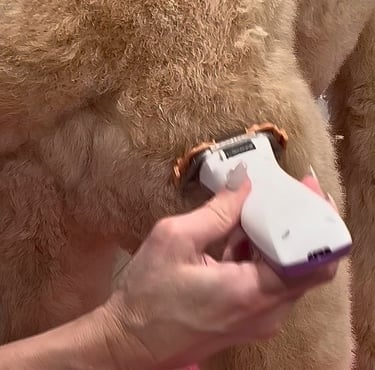
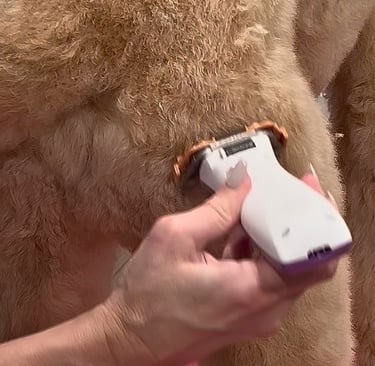
Understand how wide guard combs work, why they sometimes struggle, and the design principles that create smoother, faster, more consistent grooming results.
Wide guard comb attachments have transformed professional dog grooming by allowing groomers to leave longer coat lengths while covering significantly more coat with every pass. Simply put, they help groomers work faster without sacrificing quality.
Originally embraced for large breeds where efficiency matters most, wide guard combs quickly proved their value beyond giant coats. As professional groomers began experimenting with them on smaller breeds, sporting breeds, terriers, and a variety of coat types, many discovered something unexpected—they often preferred the performance of wide guard comb systems over traditional standard-width guard combs.
Today, it's common to see experienced groomers reaching for wide guard combs as their first choice, regardless of the dog's size.